

Optimized Coolant Chemistry Helps Prevent Ongoing Engine Issues
By William Huff, Senior Materials Science Engineering Chemist, Atmus Filtration Technologies

The bus garage for Tennessee’s Putnam County School District participated in a trial with Fleetguard that revealed the factory-fill OAT coolant used in its buses was causing hose failures. After switching formulations, the issues disappeared — proving the importance of choosing the right coolant chemistry.
Another day, another heater hose leak. At the bus garage for Tennessee’s Putnam County School District, hoses were going bad so often that the team accepted them as a routine maintenance issue.
Although buses are built on assembly lines, the process is less automated than other types of vehicle manufacturing. Much of the work is still done by hand. And if a hose isn’t tightened or clamped in the right way, it might be delivered with a leak that can be fixed quickly. But failures like the district was experiencing shouldn’t have been happening that often, if at all. If hoses are regularly crumbling later in a vehicle’s service life, it’s often a sign of a coolant problem.
Understanding how coolant works and needs to be maintained has become increasingly challenging over the last few decades. There are more options than ever today, and the anecdotal guidelines that worked in the past don’t always apply to more recent innovations. Knowing the properties of the coolant you’re using can mean the difference between an engine that runs smoothly for many years and one that slowly degrades toward potentially catastrophic failure. In fact, according to a frequently cited technical paper published by the Society of Automotive Engineers (SAE), the cooling system is involved in around 40% of all problems in heavy-duty diesel engines.
Fortunately for the Putnam County bus garage, a routine coolant sampling revealed the true source of the problem, and it could be traced all the way back to the original factory fill.
The Innovation of OAT
Most newer, diesel-powered vehicles ship with an organic acid technology (OAT) coolant or one of its variants. These coolants are formulated to deliver more effective, longer-lasting protection than conventional options.
OAT coolants were developed to extend service intervals and reduce maintenance requirements; both goals were achieved with great success. A properly maintained OAT coolant can potentially last up to 1 million miles (1.6 million kilometers) or 20,000 hours — the point where most diesel engines need to be rebuilt. Further, OAT coolants don’t need to be replaced as often because their additives are depleted at a much slower rate. The system can simply be topped off as needed with the same OAT coolant; no supplemental coolant additives (SCAs) or extenders are needed. It’s also suitable for all makes and models, from light to heavy duty, which makes it practical for mixed fleets. These advantages are significant enough that many original equipment manufacturers (OEMs) exclusively use OAT coolants or something similar.
Unlike the conventional coolants of old, which largely use similar additives, the chemistries of OAT coolants can vary widely. It’s therefore critical to know which formulation you’re using and the possible impacts it can have on your engine.
Not All OAT Coolants Perform the Same
In the case of the Putnam County bus garage, the culprit turned out to be an OAT coolant that contained 2-ethylhexanoic acid (2-EH), an additive that’s popular with many OEMs because it’s cheap to manufacture and very effective at protecting cast iron. Unfortunately, it’s also notorious for damaging silicone, which is increasingly being used for components like head gaskets, heater hoses and radiator hoses.
2-EH is banned in Europe as a hazardous material, but it’s still widely used elsewhere and is best avoided. Even if your engine is silicone-free, other components of your cooling system may not be. Most countries require the presence of 2-EH to be disclosed by law, but watch out for the term “proprietary inhibitors”, which is sometimes used to hide it on ingredient labels.
The Numbers Don’t Lie
To confirm the suspicion that 2-EH was responsible for their heater hose issues, the district agreed to participate in a collaborative study with a team of Fleetguard engineers and researchers from Atmus Filtration Technologies. A diverse group of vehicles was selected for the study:
§ Four of the district’s buses were drained and refilled with Fleetguard ES Compleat™ coolant, a hybrid or “extended-service” product that’s maintained similarly to traditional coolants. This type of coolant is often chosen when an operator wants familiar conventional coolant behavior, is comfortable with SCA management, or has a legacy fleet standardized to use a nitrite-based coolant.
§ Four buses were flushed and refilled with Fleetguard ES Compleat OAT coolant, a nitrite-free coolant that offers the longer service intervals common to OAT products with no need for SCA additions. Eliminating nitrites makes SCAs and nitrite monitoring unnecessary. It also protects aluminum surfaces in the cooling system, which can react with nitrites to create deposits that clog cooling passages and reduce heat transfer efficiency.
§ Four additional buses were left unchanged and monitored as a control group.
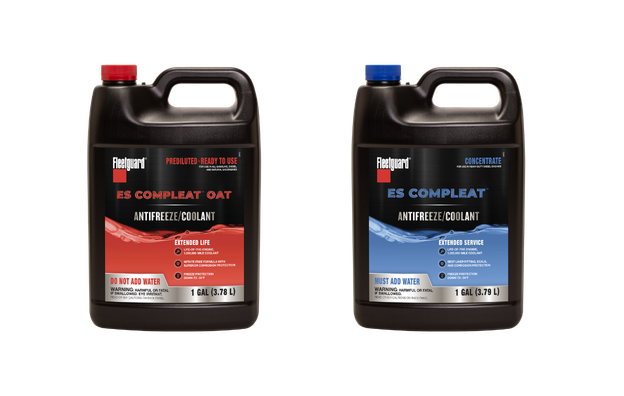
To avoid damaging silicone components, choose coolants free from 2-ethylhexanoic acid (2-EH), such as ES Compleat and ES Compleat OAT from Fleetguard.
Buses included in the study were monitored for 16 months, collectively logging more than 220,000 miles. Around 160 coolant samples were collected. Mechanics were not fully aware of which buses were part of the study, limiting anecdotal feedback on maintenance improvements.
The results were clear: Hose degradation was virtually eliminated in both groups of buses that were drained and refilled with new coolant. The control group continued to have ongoing issues with leaks and coolant loss throughout the study period.

Know Your OAT for Best Results
As this example illustrates, a simple difference between coolant formulations can significantly affect long-term equipment reliability and uptime. Once the district understood how their original coolant formulation had been causing their issues, they were advised to request that all future buses be factory-filled with an OAT coolant that didn’t contain 2-EH.
Of the two alternative coolants tested by the study, the OAT variant was considered preferable for its reduced maintenance needs, lower costs over time and longer fluid life expectancy, which is significantly longer than the planned service life of the buses themselves.

At the conclusion of the trial, the Putnam County School District bus garage decided to standardize on ES Compleat OAT coolant since it is free of 2-EH and offers reduced maintenance requirements, lower costs over time and longer fluid life expectancy.
Author Bio
William Huff is a senior materials science engineering chemist at Atmus Filtration Technologies, where he supports Fleetguard coolants, coolant filters and related products. This includes new product validation and development, solving coolant-related issues, and conducting training sessions. William has worked for Atmus for eight years, with five years of experience in the company’s coolant analysis lab. He earned a bachelor’s degree in analytical chemistry from Tennessee Technological University.