

Filters are critical components for engines and related systems. Understanding how they are rated can help you increase uptime, maximize performance, and protect your investment. All so you can run cleaner, longer.
Not All Filters are Rated the Same Way
Choosing the right filters is critical to maintaining engine and equipment health and performance over the long haul, and that starts with selecting filters that are rated in accordance with the original equipment manufacturer’s (OEM) recommendation or better. Making the right choice is easier if you understand what filter ratings really mean. The following explanations will help.
The first important thing to know is that air filters and liquid filters — like those for fuel, hydraulic fluids and lubricants — are rated differently.
Ratings for Air Filters
Ratings for air filters are expressed simply as an efficiency percentage. In the context of filters, efficiency (regardless of filter type) is a measure of how effectively a filter removes contaminants from a liquid or gas.
Efficiency ratings of air filters for engines and compressors are determined by testing in accordance with ISO 5011 requirements. During testing, a known weight of standardized test dust is fed through the filter. The filter efficiency is determined by comparing the weight of dust collected by the filter to the weight of the dust that passed through it. The more dust the filter captures, the higher the efficiency rating (percentage).
And note this: a small difference in efficiency can have a big impact on how well a filter protects your equipment. Consider that an air filter that’s 99% efficient lets 100 times more dust pass through it than a filter that’s 99.99% efficient!
Filter efficiency: a seemingly small improvement can make a big difference
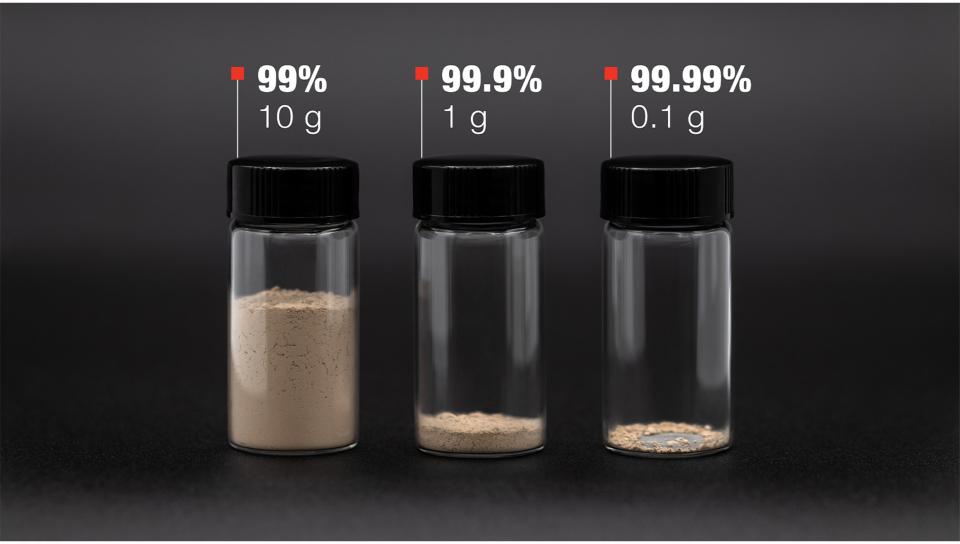
An air filter that’s 99% efficient lets 10 times more dust pass through it to equipment it’s meant to protect than a filter that’s 99.9% efficient, and 100 times more dust than a filter that’s 99.99% efficient. (Test results based on a dust load of 1,000 g.)
Ratings for Liquid Filters
Unlike air filter ratings which use an efficiency value alone, liquid filter ratings denote the efficiency with which they remove particles of a particular size. So liquid filter ratings have two components: an efficiency value and a micron rating; one is meaningless without the other.
The micron rating refers to the particle size on which the efficiency value is based.
The efficiency value for liquid filters is different than for air filters. For one thing, it’s based on particle count instead of weight. For another, it can be expressed either as a ratio or a percentage.
Beta Ratios
For high-performance filters used in today’s advanced HPCR engines and other high-pressure, tight-tolerance systems, the best way of expressing the efficiency value is by using a beta ratio. Determined by testing per ISO 16889 requirements, a beta ratio compares the number of upstream particles of a given size or larger to the number of downstream particles of the same given size or larger.
Beta ratios are written in a particular way to indicate both the particle size and the ratio.
For example, a filter with a beta ratio of 1,000 at 10 microns would be written this way: β10 = 1,000. It means that out of every 1,000 particles 10 microns or larger that enter the system, the filter allows only one to pass downstream of it. Expressed as an equation:

Common beta ratios and their meanings
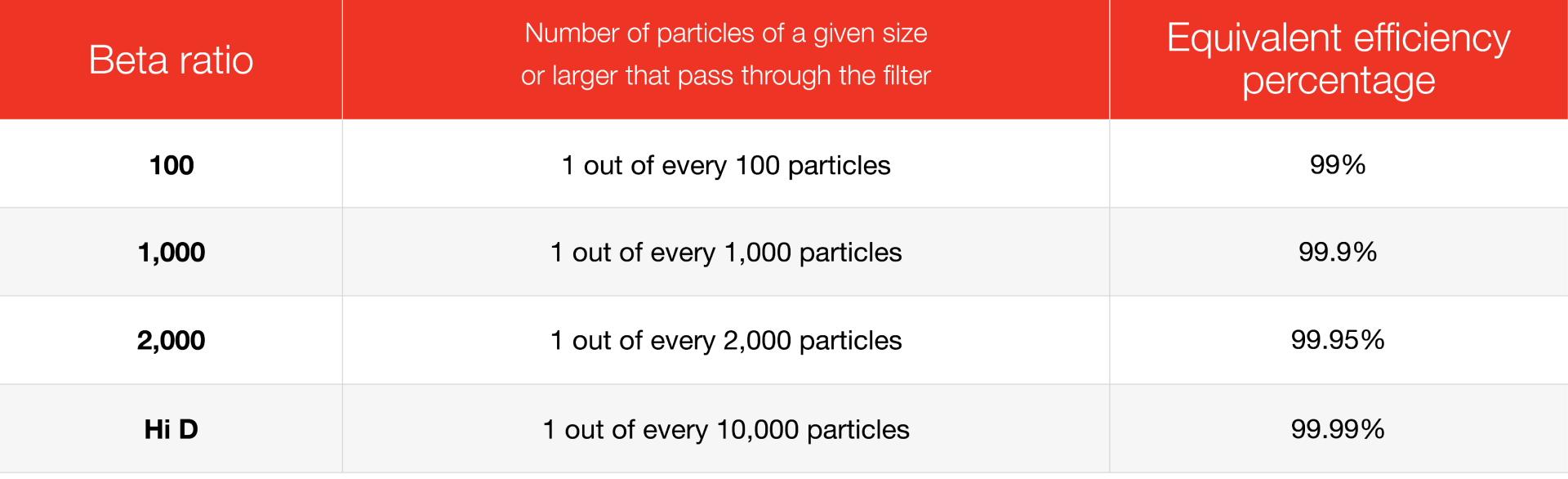
Beta ratios tell you how many particles of a given size or larger will pass through the filter. If a filter has a beta ratio of 100 at 6 microns, it means that the filter is designed to only allow one out of every 100 particles of that size or larger to pass through it.
Efficiency as a Percentage
Instead of a beta ratio, filter manufacturers may use nominal or absolute ratings — both of which express efficiency as a percentage — to indicate the performance of liquid filters.
Though not widely used anymore, a nominal filter rating signifies only that the filter will remove the majority (generally 50 to 90%) of particles of a given size. Be wary of filters with nominal ratings; they are no match for the conditions in which today’s high-performance equipment operates.
Absolute ratings are still used but their meaning has evolved, so there can be confusion about them. Historically, an absolute rating indicated a filter would capture 74 out of 75 particles of a given size, which correlates to an efficiency of 98.7%. Today, it can mean the filter is 99.9% efficient at capturing particles of a given size.
Choose the Right Filter to Increase Uptime
As with many things, you get what you pay for. Using filters that meet or exceed the filter ratings recommended by the OEM will maximize equipment life and performance and protect your investment.
And, if you want to provide even greater protection by using higher-performance filters, make sure to check with your equipment OEM, filter provider or another qualified source because there’s more to filter selection than the rating. Capacity, retention and restriction impact filter — and equipment — performance, too. But, those are topics for another day.